Generic AI writes like a robot. We trained it to write like a brand.
A deep dive into the data, the metadata, the eval and the open release behind BrandVoice. Every claim here ships with a number, a dataset or a script you can run.
The thesis
For you: the day AI starts writing, your brand stops sounding like itself, unless the voice is trained in.
Frontier models are fluent and forgettable. Ask any of them to write a tweet and you get the same smooth, hedged, middle-of-the-road voice. Marketing does not live in the middle. A brand is its voice, and a model that flattens that voice is worthless to a marketer.
BrandVoice is one marketing model adapted to carry a specific brand voice on command. The lever is not a bigger model. It is better data with richer metadata, run through Adaptive Data by Adaption.
The data
For you: the voice your customers recognize, turned into data a model can actually learn.
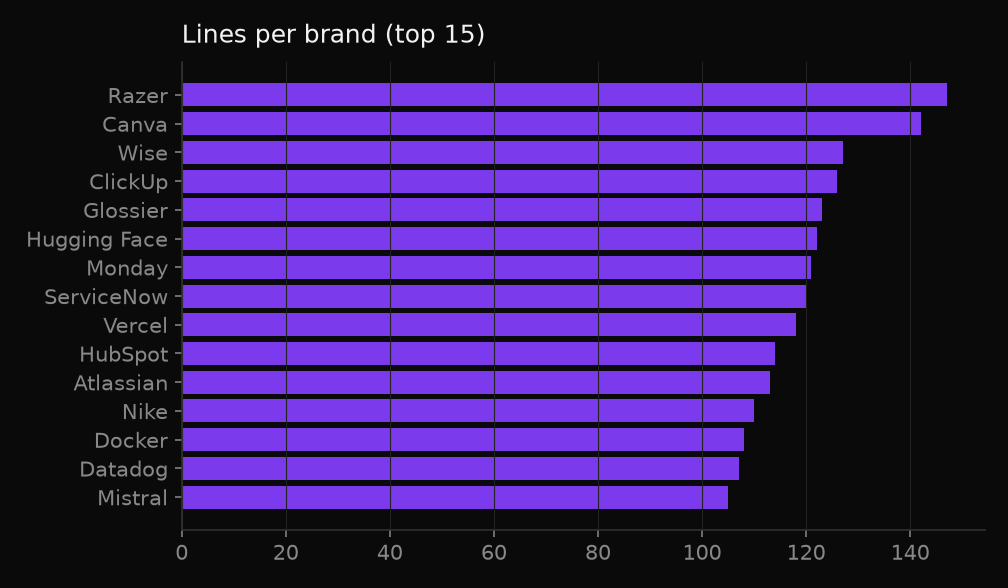
Hybrid by design, and we say so plainly. The voices are real, studied from how 83 brands actually write. The copy is generated to match each one, then every row is checked against that brand's own fingerprint. Real signal, written to spec, nothing scraped verbatim and nothing passed off as something it is not.
Liquid Death's voice is a darkly comedic, edgy, and playful tone that pokes fun at mortality and consumerism
Depth is what teaches voice
For you: every line carries the full voice, so the model writes on brand by default, not by luck.
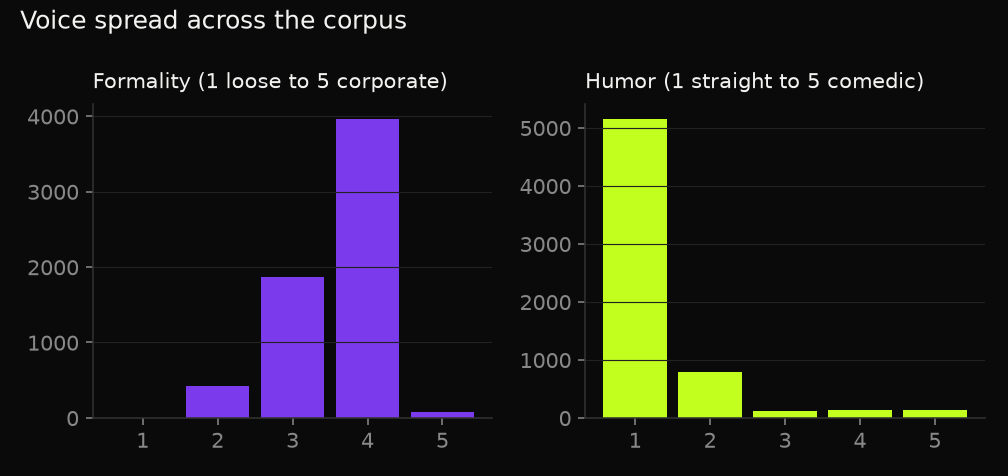
A line of copy on its own is just text. What teaches a model to write in a brand voice is the structured signal wrapped around that line: the tone it strikes, the rhythm it rides, the words it reaches for, the moves it makes. On Adaptive Data the lever is metadata fill-rate, how completely every row carries that voice signal for the recipe to train on.
So we build for depth per row. Each line carries a full voice fingerprint, not a sparse label. That is what turns a flat corpus into a teachable one.
The eval
For you: proof it works, as a number you can check, not a paragraph of adjectives.
Here is what a marketer actually wants to know: does it work, and can you prove it. Yes, and twice over. First, the number that counts. Adaption's held-out judge scored the adapted model against the exact base it was trained on.
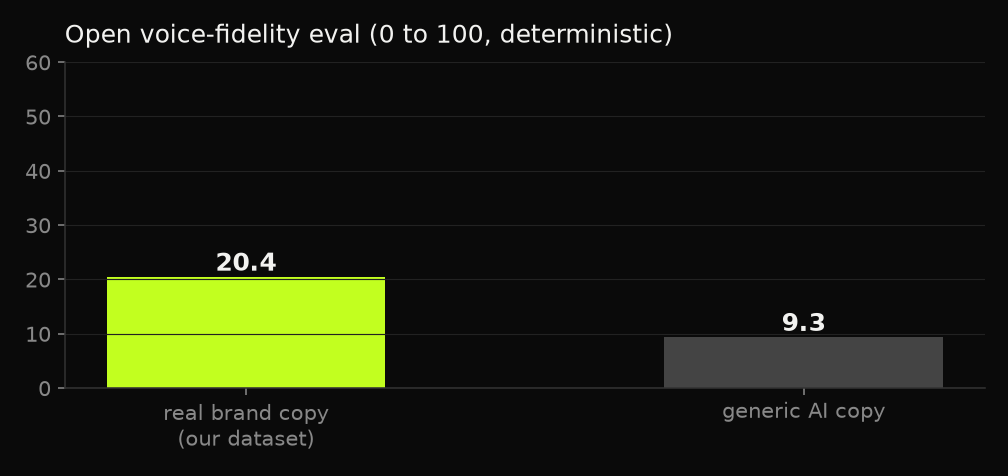
Second, our own check so you do not have to take one judge on faith. We built and open-sourced a voice-fidelity eval that combines three signals: stylometric structure, lexical vocabulary match, and an optional LLM-judge read, grounded in the style-transfer literature. It runs deterministically, with no model serving. Real brand copy from the dataset scores 20.4 of 100, generic AI filler scores 9.3. The 2.2x gap is the point: it rewards the voice and punishes the bland. This sits alongside the judged number above, not in place of it.
Open release
For you: pull it, run it, verify the result yourself. Nothing here asks for your trust.
Everything is public and runnable. The dataset is CC0, the weights are Apache-2.0, both on Hugging Face and Kaggle. Pull the data, inspect the fingerprints, load the adapter, rerun the number. This is the part most entries skip, and it is why the result holds up to inspection instead of living in a demo clip.