AutoScientist Challenge / Marketing
The moment AI writes for you,
you sound like everyone else.
Same cadence. Same three adjectives. Same nothing. The one voice customers knew you by, gone in a week. Voice isn't a vibe. It's a pattern. And patterns can be learned from real copy.
Trained on6,403 lines83 real brandsa 15-field voice fingerprint on every line
Pick a voice to steal
PARENTING IS AN EXTREME SPORT
MURDER YOUR THIRST
DEATH TO PLASTIC BOTTLES
This page previews the voice by steering an open model with the exact fingerprint the dataset encodes, 15 fields per line. The real model is already trained and judged: Adaption's held-out judge scored it +24.3%, 56% win rate against the base model. What you type below is a taste of that.
The result, measured not claimed
We didn't promise a lift. We trained the model, then let the judge score it.
Most entries stop at a dataset and a demo clip. We ran the full adaptation on Llama 3.3 70B, then put the fine-tuned model in front of Adaption's held-out judge. Every number below is straight from the run. Nothing rounded up.
adaption_llama_3_3_70b_instru_b2b_saas_marketing_copy
A real LoRA adapter on Llama 3.3 70B Instruct. Together AI weights export. Public, downloadable, rerunnable.
Weights on Hugging Face →Straight with you: this is a first, light run. One epoch, a small LoRA. The lift is real and the pipeline is proven end to end. Bigger runs are headroom, not a different method. We'd rather show you a true 24.3% than a fake 60.
Adaptive Data → AutoScientist → HF / Kaggle → live demo
6,403 fingerprinted brand lines ingested and adapted into a co-optimised training set.
Llama 3.3 70B fine-tuned on the set. Adaption's judge scored it +24.3% over baseline.
Dataset CC0 plus LoRA weights, public and rerunnable. The part most entries skip.
View dataset →Before and after, read it without running anything
Generic AI writes the beige average. The dataset writes the brand.
Five real lines from the corpus, each next to the safe, on-message thing a generic model reaches for. Same product, same brief. One of them sounds like a company. The other sounds like the company.
Stay refreshed with our premium still water, sustainably sourced for you.
Murder your thirst.
A reliable solution to help your business accept payments online.
The backbone of global commerce.
An all-in-one productivity tool to help your team stay organized.
Meet the night shift.
A plant-based milk alternative made from high-quality oats.
It is like milk, but made for humans.
Learn a new language with our easy and effective online courses.
Your lesson is waiting, and so is the owl.
Open eval and dataset quality
We built our own eval too, and we are honest about what it says.
Alongside Adaption's judged +24.3%, we ship a deterministic voice-fidelity eval that needs no model serving. It scores real brand copy at 20.4 out of 100 against 9.3 for generic AI copy, a 2.2x separation measured across 498 real lines and 120 generic ones. The absolute numbers run low because many lines are short taglines. The point is the gap, and the gap is what proves the released dataset carries real brand voice.
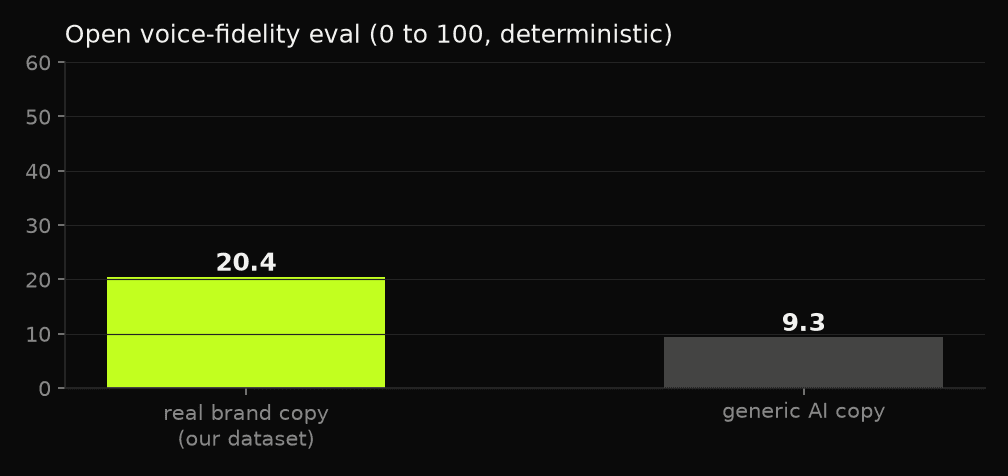
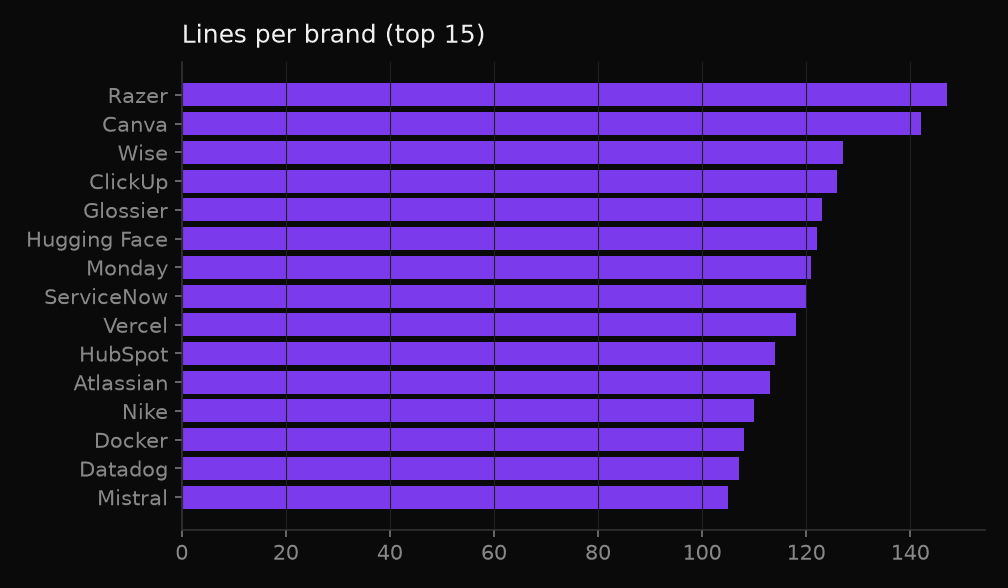
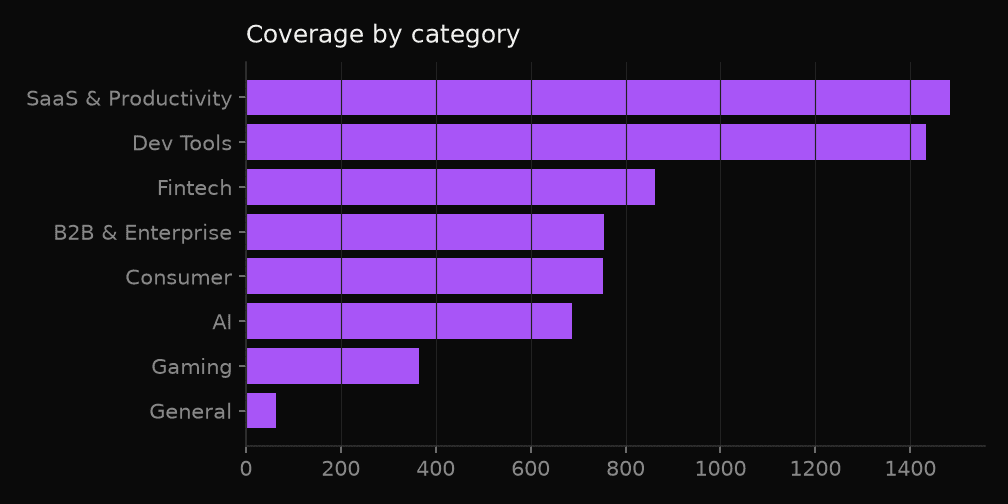
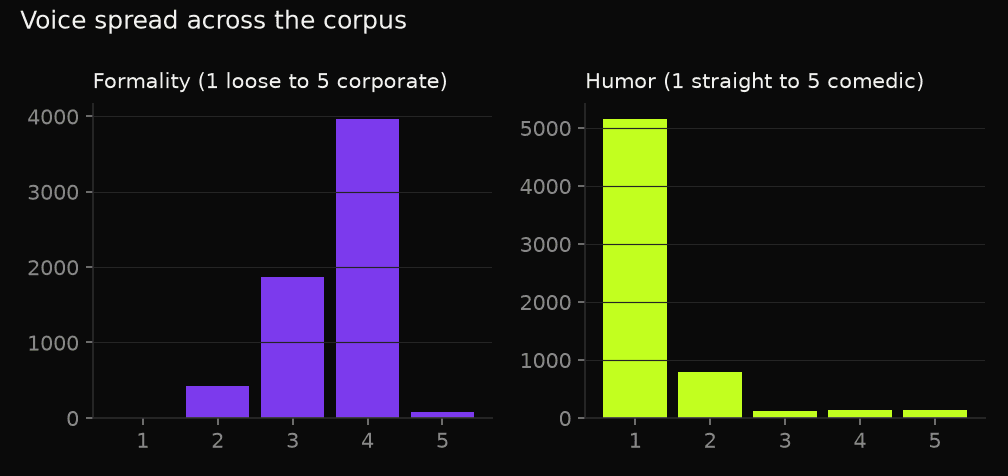
Deterministic, no model serving in the loop. Grounded in the style-transfer evaluation literature: arXiv 2508.06374, Evaluating Style-Personalized Text Generation and arXiv 2502.04718, Text Style Transfer Evaluation. The harness is open at eval/voice_fidelity_eval.py.
This eval sits alongside Adaption's +24.3%, it does not replace it. The judged copy-quality lift is the headline. This open eval is the second opinion: a fast, reproducible check that the 6,403 rows, 83 brands, and 64 distilled marketing-craft principles in the released dataset actually encode brand voice rather than the beige average. Run it yourself against the public dataset.
- 0real brand voices learned, Stripe to Liquid Death
- 0lines of real copy, every one fingerprinted
- 0voice fields tagged per line, 100% filled
- 0channels it writes, one tweet to a changelog
The pipeline / 04 steps
A brand voice goes in. A model that keeps it comes out.
No prompt engineering on your end, no drift to police. The voice is part of the weights, and the gain is a number you can check yourself.
Read the voice off real copy
Before a word gets written, every brand gets a 15-field fingerprint pulled from how it actually writes: cadence, the three adjectives it leans on, the moves it always makes, the ones it never does. This is the part most tools skip and then sound generic.
Pair each brief with on-brand copy
You feed it a real marketing brief; it returns a full piece a copywriter would sign off on. Posts, emails, landing heroes, changelogs. Not taglines, not filler. 6,403 lines, every one checked against the brand's own fingerprint at a 100% fill rate.
Bake the voice into the weights
Adaption co-tunes the data and the training recipe until the model writes on brand by default. You stop babysitting a prompt that drifts by the third paragraph; the voice is now behavior the model can't forget mid-draft.
Get the lift as a checkable number
A held-out judge scores the adapted model against the base on copy it never saw: 7.0 to 8.7, a 56% win rate. Then the data and the LoRA weights go public on Hugging Face and Kaggle, so the number isn't a claim. It's something you can rerun.
Why this and not the default
The moment AI starts writing, most brands lose the one thing customers recognized them by.
Same cadence, same three adjectives, same nothing. Gone in a week. Voice isn't a vibe you prompt for. It's a pattern, and patterns can be learned from real copy.
It writes like your brand, not like a model
Stripe stays precise and quiet. Liquid Death stays loud and funny. Each voice is pinned down to cadence, vocabulary, and the rules a brand keeps and breaks. So the copy reads like someone on your team wrote it, not like the same assistant 10,000 other companies are renting.
We tell you it's hybrid, on purpose
The voices are real, studied from how 83 brands actually write. The copy is generated to match them, every line checked against that brand's own fingerprint. No scraping, no pretending a synthetic line is something it isn't. The honesty is the point. It's why you can trust the rest of the page.
The lift is measured, not adjectives
A held-out judge scored the adapted model against the base on copy it never saw.
- Copy quality
- 7.0→8.7+24.3%
- Win rate vs base
- 56%
One epoch, light LoRA. A real first run. The lift is real and the pipeline is proven end to end. Bigger runs are headroom.
Open release
Everything is public. Download it, rerun it, check the number yourself.
The dataset is CC0. The weights are Apache-2.0. Both ship on Hugging Face and Kaggle, with the evaluation and exact reproduction steps. Most entries publish a demo and a claim. We publish the whole loop.
- Adapted dataset on Hugging Face and Kaggle
- Model weights on Hugging Face and Kaggle
- Measurable improvement vs baseline: +24.3% quality, 56% win rate
- Live demo, built on Adaptive Data by Adaption